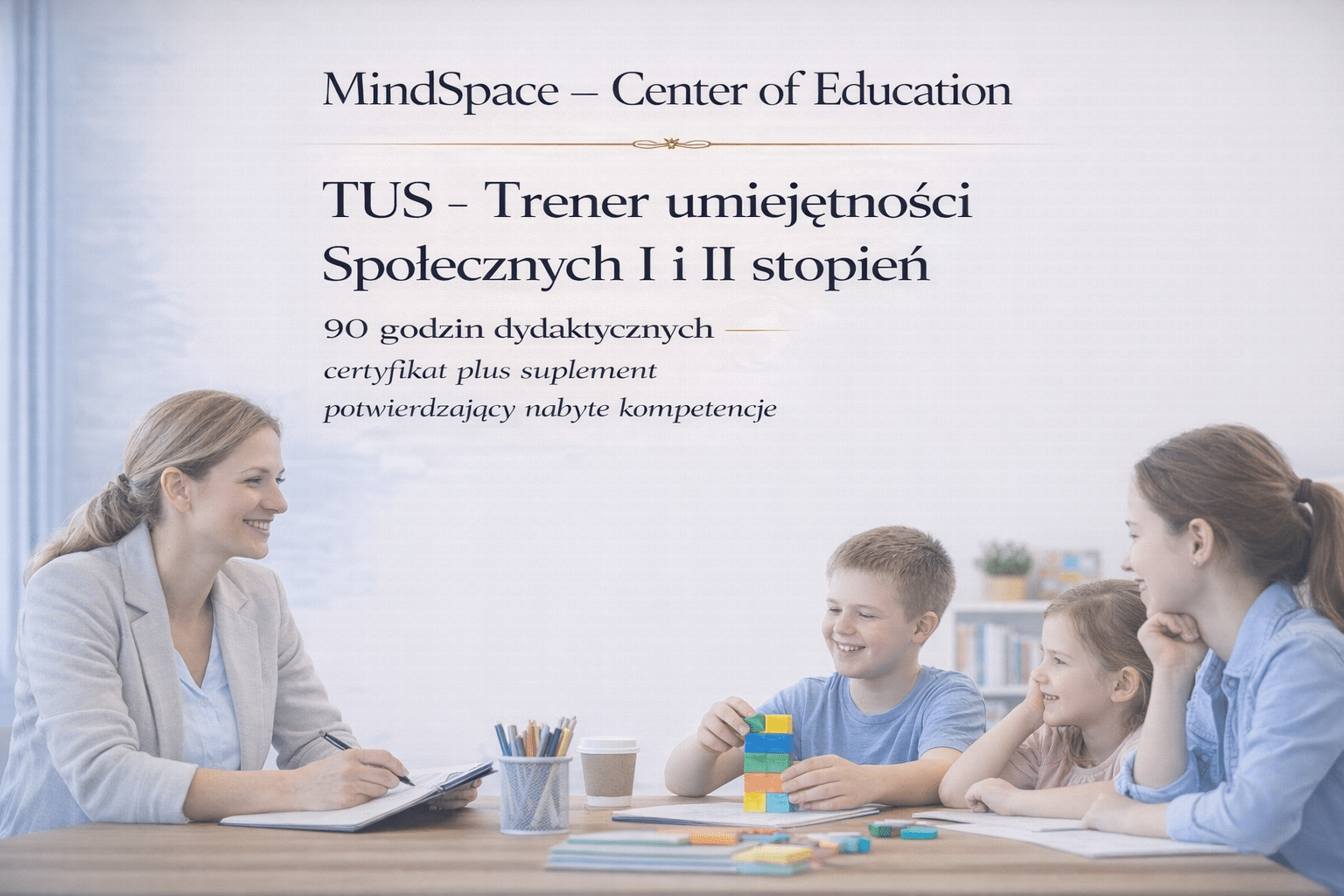
TUS – Social Skills Trainer Level I and II
About the course
Social Skills Training (SST) is a systematic and empirically grounded educational method aimed at developing participants' interpersonal, communication, and emotional skills. It is a structured learning process based on the principles of social psychology, pedagogy, and social learning theory, focused on developing adaptive patterns of social behavior.
The basic assumption of this methodology is the belief that social skills are acquired through systematic learning and can be effectively developed through appropriate educational interventions. The program covers a wide range of social skills, including verbal and nonverbal communication, assertiveness, cooperation, conflict resolution, emotion regulation, and building positive interpersonal relationships.
This approach is distinguished by its structured organization of the learning process, use of experiential techniques, systematic reinforcement of acquired skills, and comprehensive evaluation of participants' progress in controlled and natural conditions.
Upon completion of the program, participants receive a personalized certificate and a descriptive supplement documenting the program's subject matter, learning outcomes achieved, and the number of hours of independent study completed by the participant. The supplement is prepared in accordance with European standards for the description of learning outcomes and contains information used in ECTS credit recognition procedures.
Course content
Module I Conceptualization of social skills training – level I
-
Basic methodological assumptions
-
The importance of social skills in personal development
-
Stages of social skills development in children and adolescents
-
Neurobiological mechanisms of social competence development
-
The origins and evolution of the TUS methodology
-
Theoretical foundations of the TUS methodology
-
Individual and group goals
-
Research methodologies at TUS
-
Classification of disorders and indications for TUS – when to use TUS, contraindications, comorbidity
-
Interdisciplinary cooperation – working with psychiatrists, educators, and parents
-
Legal and ethical framework for work – consent, confidentiality, limits of competence, child protection
-
Measurement and evaluation of effectiveness – tools – add them because they are not done yet.
-
Task – case study
12:00 a.m. -
Recommended reading
-
Assess the truthfulness of the following statements by selecting True or False.
-
Printable material
Module II Professional competencies of a TUS specialist in working with children and young people
Module III Recognizing difficulties in TUS in children and adolescents
Module IV Methodology of organizing social skills training for children and adolescents
Level II – Advanced TUS Techniques
The specifics of working on social skills development
Course completion – Certification
Student ratings and reviews