Accessibility

Imieniny: Name day: Іменини: Infolinia: Hotline: Гаряча лінія: pon.–pt. 8:00–16:00 Mon–Fri 8:00–16:00 Пн–Пт 8:00–16:00 PL: 570 828 313 UK: 07934 470589 office@mindspace-edu.com

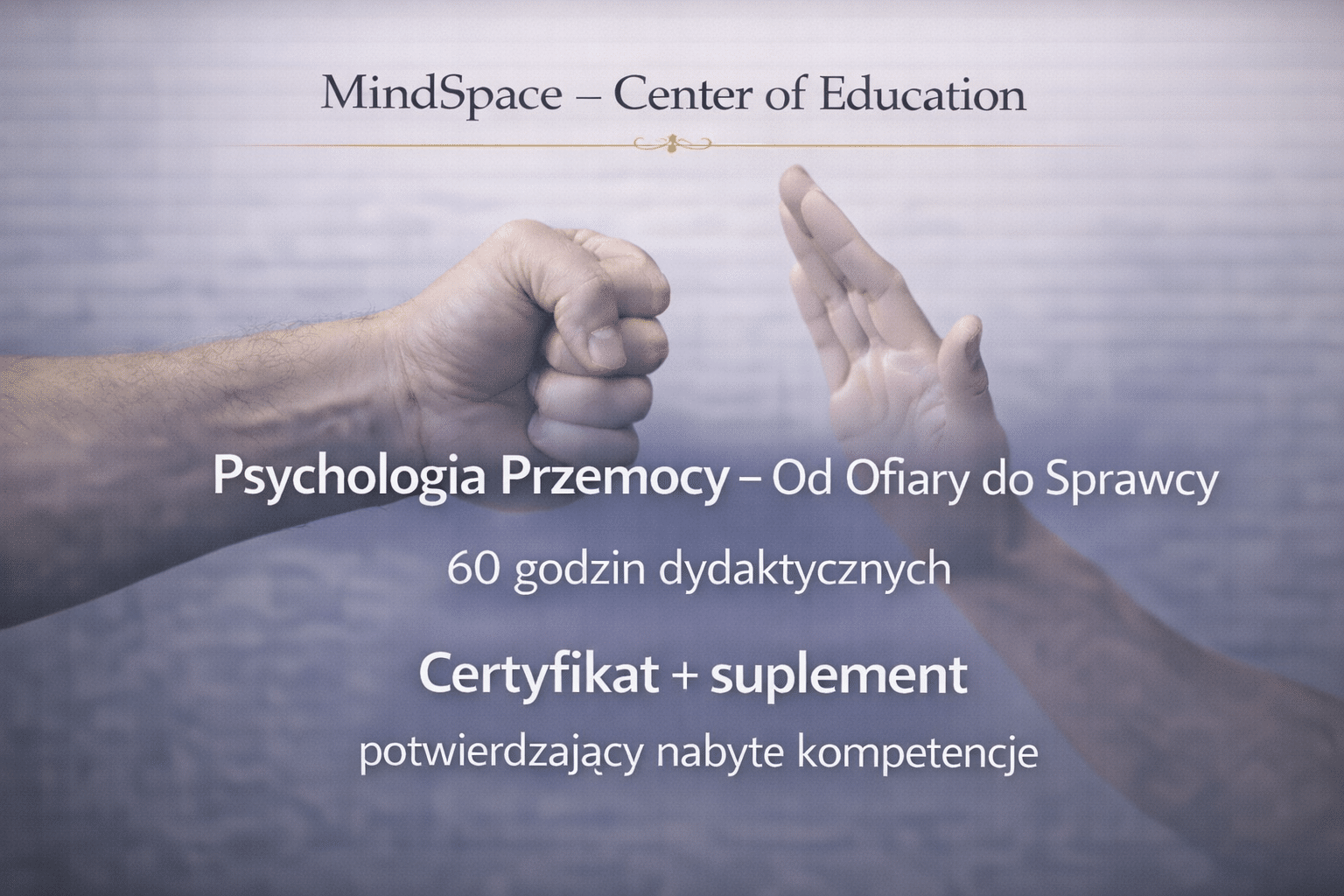
The Psychology of Violence – From Victim to Perpetrator
Categories:Psychology
Wish list Share
Share the course
Website link
Share on social media

About the course

Course "Psychology of Violence – From Victim to Perpetrator" is a psychoeducational program that broadens knowledge in the area of the mechanisms of violence, its psychological determinants, and its effects on individuals and society. The course does not confer professional qualifications or therapeutic credentials ; its aim is to deepen understanding of the phenomenon of violence from the perspective of psychology, interpersonal relationships, and mental health.

The aim of the course is to present the complexity of violence, from the role of the victim to the mechanisms of the perpetrator, and to develop psychological awareness of the emotional, cognitive, and social processes accompanying these experiences.
Participants will learn the theoretical foundations of the dynamics of violence, as well as ways of responding and preventing it in professional, educational, and personal contexts.

Upon completion of the program, participants receive a personalized certificate and a descriptive supplement documenting the program's subject matter, learning outcomes achieved, and the number of hours of independent study completed by the participant. The supplement is prepared in accordance with European standards for the description of learning outcomes and contains information used in ECTS credit recognition procedures.

Show more

What will you learn?

  • The aim of the course is to present the complexity of violence, from the role of the victim to the mechanisms of the perpetrator, and to develop psychological awareness of the emotional, cognitive, and social processes accompanying these experiences.

Course content

Module I – Introduction to the psychology of violence
Violence is a phenomenon as old as humanity itself, yet it remains poorly understood. It is not a random outburst of emotion or a momentary loss of control; it is a complex psychological mechanism with its own causes, course, and consequences. The psychology of violence examines why some people harm others, how patterns of aggression are formed, what mechanisms enable perpetrators to rationalize their actions, and why victims often remain in destructive relationships. It also analyzes how trauma affects the brain, how violence is passed down from generation to generation, and what causes former victims to sometimes become perpetrators themselves. This field requires looking at people without simplifying, on the one hand, not justifying violence, and on the other, trying to understand its mechanisms.

  • Lesson 1. Definitions and types of violence – psychological and social perspectives
  • Lesson 2 Psychological mechanisms of violence – from impulse to established pattern
  • Lesson 3. Psychological profile of a victim of violence – emotions, identity, and the adaptation process
  • Lesson 4. Topic 4 Psychological profile of perpetrators of violence – sources, motivations, and control mechanisms
  • Lesson 5 The dynamics of the victim-perpetrator relationship – psychological interdependence and traumatic bonding
  • Lesson 6 The process of recovering from violence – stages, support, and psychological recovery
  • Case Study 1. – Psychological abuse in a relationship
  • Case Study 2 – Psychological mechanisms of violence: from impulse to established pattern
  • Case Study 3 – Psychological profile of a victim of violence: emotions, identity, and the adaptation process
  • Case Study 4 – Profile of the perpetrator of violence: sources, motivations, and control mechanisms
  • Case Study 5 – The dynamics of the victim-perpetrator relationship and the traumatic bond
  • Case Study 6 – Violence against children and intergenerational transmission
  • Final test – Module I: Psychology of psychological violence

Module II – Psychological underpinnings of violence and the process of internalizing aggression
Violence does not arise in a vacuum. Behind every act of aggression lies a complex network of psychological, neurobiological, and environmental factors that have shaped over the years the way a person deals with emotions, stress, and relationships with others. The process of internalizing aggression is the gradual absorption of violence as a natural way of functioning. A child who grows up in a violent environment learns that shouting is a way of communicating and that force is a tool for resolving conflicts. These patterns become deeply ingrained in the psyche, often outside of consciousness, and can be triggered in adulthood in situations of stress or danger. However, internalization does not mean determinism. It is a complex process influenced by protective factors such as safe relationships, social support, and personal psychological resilience. Not everyone who has experienced violence uses it themselves. But understanding how aggression becomes part of a person's inner world allows us to better understand the mechanisms of its formation and intergenerational transmission. This knowledge is crucial for anyone who wants to understand why violence repeats itself and how this cycle can be broken.

Module III: The psychology of perpetrators of violence
The psychology of the perpetrator of violence The perpetrator of violence is not a monster from fairy tales or an inherently evil being. They are a person with their own history, traumas, and psychological mechanisms that led them to cross another person's boundaries. Understanding this does not mean justifying it—it means attempting to get to the root of violent behavior. The psychology of the perpetrator reveals a complex network of factors: personality disorders, defense mechanisms, cognitive distortions, and patterns learned in childhood. The perpetrator often functions in a reality that he has constructed for himself—where violence is justified, where the victim "deserves it," where he himself is the one who "must restore order." This inner world of the perpetrator, though distorted, has its own logic. Defense mechanisms protect him from confronting the reality of his actions, rationalizations allow him to maintain a positive self-image, and projection shifts the blame onto others. This does not mean that the perpetrator is not responsible—on the contrary, understanding these mechanisms may be the key to breaking down his resistance and bringing about real change. Without insight into the perpetrator's psyche, effective therapy, prevention, or breaking the cycle of violence is impossible. Retry

MODULE IV – VIOLENCE IN FAMILY AND INSTITUTIONAL SYSTEMS
In a world of social relationships that should provide people with a sense of security, stability, and trust, it sometimes happens that structures established to protect and support become a source of pain, fear, and helplessness. The fourth module of the course "Psychology of Violence – From Victim to Perpetrator" addresses the extremely important and difficult topic of systemic violence, embedded in the family and institutional context. This is a space where the boundaries between help and harm are not only blurred, but also socially invisible.

Module V – Cycle of Violence
The cycle of violence is a recurring pattern of behavior in abusive relationships that keeps victims trapped in destructive relationships despite their awareness of the harm being done. This phenomenon explains why people return to abusers and why it is so difficult to break free from toxic relationships.

Module VI – Prevention and psychological intervention in the area of violence
Violence destroys the lives of millions of people around the world. Behind every statistic is a human being—a child who is afraid to go home, a woman hiding bruises under makeup, a man plunged into depression after years of psychological abuse. Every day, someone makes a dramatic decision – whether to stay and endure further harm, or to leave and face an uncertain future. Prevention and psychological intervention are not just a set of techniques or procedures – they are hope for ending suffering and rebuilding a life. It is the moment when someone hears for the first time that the violence is not their fault. It is the moment when a child learns that there are adults who can protect them. It is a process in which a person slowly regains their self-esteem after years of abuse. Effective intervention can mean the difference between life and death, between the continuation of violence and its cessation, between passing on trauma to the next generation and building healthy relationships. Every right action, every appropriately spoken word, every moment of understanding can become a turning point in someone's life. Psychologists, therapists, social workers, doctors, teachers—all those who encounter violence in their work—bear a tremendous responsibility. Their response can restore hope or destroy it, save a life or contribute to further harm.

Violence takes away your voice. A professional restores it with awareness, empathy, and courage.
The path from victim to perpetrator is one of the most tragic aspects of violence. It shows how harm can spread, how one person's trauma becomes a source of suffering for others. This mechanism is neither simple nor straightforward. Behind every act of violence there may be a different story—childhood trauma, mental disorder, brain damage, untreated illness, desperation, helplessness. There is no single cause, no simple answers. The psychological mechanisms presented here are intended to help understand the phenomenon, not to pass moral judgments. Violence can be studied, analyzed, and prevented. Please remember that every case is different, every person is different.

Course completion – certification
Congratulations on completing the course! Thank you for your trust and commitment during your studies. We hope that the skills you have acquired will prove useful in your daily work. We encourage you to continue developing your skills and putting your acquired knowledge into practice. We wish you success in your further development and satisfaction in achieving your goals! With kind regards, The MindSpace Team

Student ratings and reviews

No reviews
No reviews

Want to receive push notifications for all major on-site activities?